
California’s Latest Earthquake Is a Real Estate Wake-Up Call... Not Just a News Headline
A professional real estate analysis of California’s latest earthquake, explaining how seismic risk, aftershocks, earthquake insurance, retrofits, inspections, and buyer due diligence affect property value, safety, and long-term ownership strategy.
Tony El Fata
6/25/20265 min read
A magnitude 5.6 earthquake near Redwood Valley and Willits in Mendocino County reminded California of one uncomfortable truth: earthquake risk is not theoretical. It is not just a line on a hazard map, a clause inside an insurance document, or a dramatic headline about “The Big One.” It is a real force that can shake homes, close businesses, damage infrastructure, trigger power outages, and instantly change the way buyers, sellers, lenders, insurers, and investors look at property.
The June 24, 2026 Northern California earthquake was not catastrophic by California standards, but it was powerful enough to be widely felt, strong enough to knock items from shelves, and serious enough to trigger emergency response, injuries, aftershocks, and renewed public fear. Online, the trending keywords tell the story clearly: “California earthquake,” “5.6 magnitude,” “Redwood Valley,” “Willits,” “Mendocino County,” “aftershocks,” “ShakeAlert,” “Maacama Fault,” “San Andreas,” “Big One,” “earthquake damage,” “earthquake insurance,” and “seismic retrofit.”
But for real estate, the most important keyword is this: risk.
Earthquake risk is not just about whether a home is standing today. It is about how that home was built, what soil it sits on, how it is connected to its foundation, whether it has cripple walls, whether the water heater is strapped, whether the chimney is reinforced, whether the foundation shows movement, whether older framing has been upgraded, whether the property is insurable, and whether the buyer has a realistic plan after closing.
That is where real estate needs to become more intelligent.
Too many buyers shop for square footage, countertops, views, interest rates, and monthly payments, while ignoring the physical risk profile of the structure itself. A beautiful home in an earthquake-prone region can still carry hidden exposure. The question is not simply, “Can I afford this property?” The better question is, “Can this property survive the risk environment it lives in?”
A moderate earthquake is often the perfect warning because it exposes weakness without always causing total destruction. It reveals what falls, what cracks, what shifts, what loses power, what businesses close, what systems fail, and which properties were prepared versus which were merely lucky. That matters deeply for buyers and owners.
In California, a home is not just a home. It is a structure sitting inside one of the most active seismic regions in the United States. The Maacama Fault, Hayward Fault, Calaveras Fault, San Andreas Fault, and other fault systems are not abstract geological names. They are part of the real estate equation. They affect safety, value, insurance, financing, repairs, disclosure, marketability, and long-term ownership strategy.
The trending fear online is predictable: “Is this a warning before the Big One?” That question gets clicks. It creates panic. It spreads fast on social media. But the more professional real estate question is different: “Is my property ready for the next earthquake, whether it is small, moderate, or major?”
That is the question every serious buyer, seller, landlord, investor, and agent should be asking.
For buyers, earthquake due diligence should begin before writing an offer. A property’s age, foundation type, construction method, visible cracking, drainage, slope, retaining walls, chimney condition, garage openings, soft-story design, and prior retrofit work all matter. Older homes can be charming, but charm does not replace structural evaluation. A house built before modern seismic standards may need closer attention, especially if it has not been retrofitted.
For sellers, earthquake awareness can become a trust advantage. A seller who understands the home’s condition, gathers records, discloses known issues, and documents retrofit work can stand out in a cautious market. In a post-earthquake news cycle, buyers become more alert. They ask sharper questions. They look harder at cracks. They worry about insurance. They wonder whether today’s dream home could become tomorrow’s financial trap.
For investors, earthquake risk must be priced into the deal. The purchase price is only one part of the equation. Repairs, insurance gaps, retrofit costs, vacancy risk, tenant safety, business interruption, emergency access, and resale liquidity all belong in the analysis. A property that looks profitable on paper can become fragile when natural hazard risk is ignored.
For landlords, habitability and safety should be treated as core business obligations. Earthquakes can damage stairs, water heaters, gas lines, electrical systems, foundations, roofs, chimneys, and interior finishes. Even when a building does not collapse, it can become unsafe or temporarily unusable. Tenants do not care about an owner’s spreadsheet when the structure they live in feels unsafe.
For agents, this is where professionalism must rise. Real estate should not be reduced to opening doors and chasing commissions. A skilled agent should help clients think beyond emotion. The best real estate strategy includes market analysis, financing analysis, exit planning, hazard awareness, inspection review, insurance review, and risk management.
This does not mean agents should pretend to be engineers, geologists, or insurance adjusters. They should not. But they should know when to recommend qualified professionals. A buyer may need a structural engineer. A homeowner may need a seismic retrofit contractor. A property owner may need an insurance review. A seller may need to gather permits and repair history. A landlord may need a safety inspection after shaking.
Earthquake insurance is another major issue. Many homeowners assume standard homeowners insurance covers earthquake damage. In many cases, it does not. That misunderstanding can become financially devastating. Earthquake insurance, deductibles, coverage limits, exclusions, additional living expenses, and retrofit incentives should be reviewed before disaster strikes, not after the foundation cracks.
The June 2026 Northern California earthquake also highlighted the role of early-warning systems like ShakeAlert. Alerts can give people seconds of warning... enough time to drop, cover, and hold on; move away from glass; pause surgery; slow trains; open firehouse doors; or shut down sensitive systems. That technology is important, but it does not replace preparation. A phone alert cannot bolt a house to its foundation. It cannot retrofit a soft story. It cannot strap a water heater. It cannot create an emergency plan after the shaking starts.
Real estate buyers should also understand that earthquake risk is not uniform. Two homes in the same city can carry very different risk profiles. One may sit on better soil. One may be retrofitted. One may have a stronger foundation. One may have unpermitted additions. One may have slope movement. One may have an old masonry chimney. One may have a garage design that creates structural weakness. This is why property-specific due diligence is more powerful than generic fear.
The goal is not panic. The goal is strategy.
A serious real estate strategy asks:
What hazard zone is the property in?
What fault systems are nearby?
What year was the home built?
Was it built or upgraded under stronger seismic codes?
Is the foundation visible and sound?
Is the home bolted to the foundation?
Are there cripple walls, and are they braced?
Is there a soft-story condition?
Are retaining walls, slopes, decks, stairs, chimneys, and utility connections stable?
Is earthquake insurance available and financially realistic?
What is the exit plan if the market shifts after a damaging event?
That is how real estate becomes intelligent.
California’s latest earthquake should not be treated as just another trending headline. It should be treated as a professional reminder that real estate is physical, local, structural, financial, and environmental all at once. A home is not only an asset. It is a shelter. It is a risk container. It is a long-term responsibility.
When the ground shakes, weak assumptions collapse first.
The buyers who win are not always the ones who move fastest. They are the ones who understand what they are buying. The sellers who stand out are not always the ones with the prettiest staging. They are the ones who provide clarity. The agents who matter most are not the loudest online. They are the ones who help clients see what others ignore.
Earthquakes do not destroy every property. But they do expose every shortcut.
In California real estate, earthquake risk is not a side note. It belongs in the center of the conversation.
Written by Tony El Fata | For questions or real estate guidance, contact: tonyelfata@gmail.com
Disclaimer: This article is for general educational and real estate risk-awareness purposes only. It is not legal, engineering, geological, insurance, financial, or emergency-management advice. Buyers, sellers, landlords, and investors should consult qualified professionals, including licensed real estate agents, structural engineers, geologists, insurance advisors, inspectors, contractors, and local authorities before making property decisions related to earthquake risk.
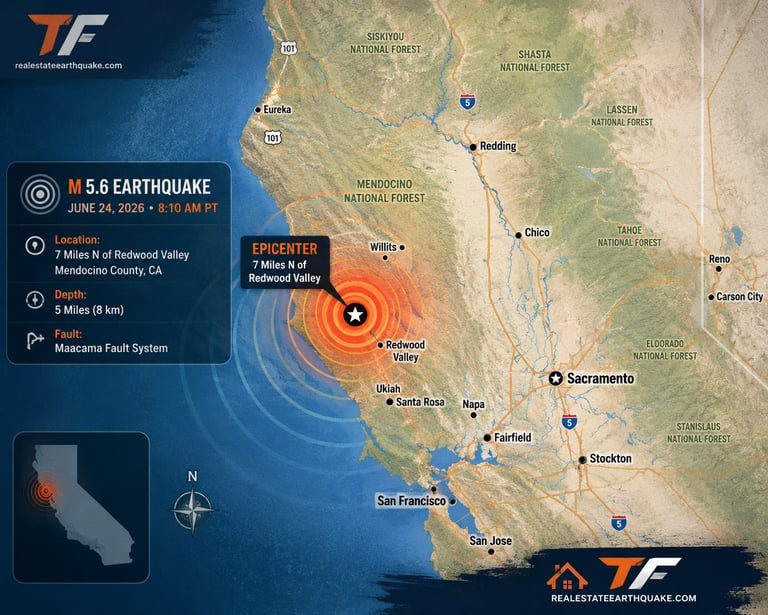
USGS Earthquake Info
M5.6 earthquake
June 24, 2026... 8:10 AM PT
Near Redwood Valley / Willits, Mendocino County, CA
Depth: ~5 miles / 8 km
Area: Maacama Fault system
Impact: Felt widely, aftershocks reported, local damage and outages.
Credit line:
Earthquake data: USGS | Graphic: TF / RealEstateEarthquake.com
Real estate services provided by Real Broker
Brokerage License: RB-2337 Brokerage Address: 2176 Lauwiliwili Street, #1 Kapolei, HI 96707
Tony El Fata, RA | RS-88598 reach out anytime for your free strategy call
Phone
tonyelfata@gmail.com
808 765 9584
Tony El Fata © 2026. All rights reserved.


Disclaimer: Real Estate Earthquake provides general real estate education, research, and buyer strategy guidance only. The information on this website is not legal, tax, financial, geological, engineering, insurance, lending, or inspection advice. Lava zone information, hazard maps, property conditions, insurance availability, financing options, permits, zoning, and public records should be independently verified with official government sources, licensed professionals, insurers, lenders, surveyors, inspectors, engineers, and qualified experts before making any real estate decision. Tony El Fata is a Hawaiʻi real estate salesperson affiliated with Reak Broker. Real Estate Lava Zone is an educational marketing resource and is not a separate brokerage.